Graduate Marine Engineering Course
If you are a Mechanical Engineer and want to join the Merchant Navy engine department, Graduate Marine Engineering is one of the most practical routes.
This route is useful, but it is often explained inaccurately or incompletely. Many students are told only three things: GME is a one-year course, it is meant for Mechanical Engineers, and after completing GME, you become an Engine Cadet. However, this explanation is incomplete and does not accurately cover the full pathway.
The simple version is this:
- GME is a one-year marine-engineering training route for eligible mechanical engineering graduates.
- It helps you move from a shore-based engineering background into shipboard engineering.
- Completing GME alone does not make you a Fourth Engineer instantly.
- You still need structured shipboard training or sea service and the MEO Class IV competency route.
If you want a broader comparison of routes, you can also read how to become a marine engineer. In this blog, we stay focused only on the GME route.
What Is Graduate Marine Engineering?
Graduate Marine Engineering, or GME, is a specialised training programme for eligible mechanical engineering graduates who want to work in the Merchant Navy as engine-side officers.
In simple terms, GME does one job: it converts a mechanical engineering graduate into a trainee for shipboard marine engineering.
A Mechanical Engineering graduate already knows the basics of:
- Thermodynamics
- Fluid mechanics
- Heat transfer
- Machine design
- Manufacturing and maintenance basics
But a ship is a different environment. A marine engineer must understand ship-specific systems such as:
- Main engines and diesel generators
- Boilers, pumps, compressors and purifiers
- Piping systems and valves
- Fresh-water generators
- Refrigeration and air-conditioning systems
- Electrical and automation systems
- Shipboard safety and pollution-prevention systems
So, the real purpose of GME is to bridge that gap between classroom engineering and shipboard engineering.
GME Course Eligibility Criteria
This is the section where most confusion happens. The first thing to understand is simple:
- DG Shipping eligibility and institute eligibility are not always the same.
- You may be eligible under regulations, but a company or college can still apply stricter rules.
- So always check both: regulatory eligibility and institute-specific eligibility.
Educational Qualification
The main eligible categories generally include:
- B.E./B.Tech Mechanical Engineering
- Certain Mechanical-core engineering streams
- Eligible Naval Architecture streams
- B.E./B.Tech Marine Engineering from a non-DGS-approved route, subject to rules and institute acceptance
A practical caution is needed here. That last category is valid under DG Shipping rules, but not every institute openly accepts it. So if someone comes from a non-DGS-approved Marine Engineering route, they must verify the current admission rule of the specific institute before applying.
Minimum Marks and English
The usual benchmark is:
- At least 50% in the final year of the qualifying engineering degree
- At least 50% in English in Class 10, Class 12 or degree level
But do not treat 50% as a guaranteed ticket. Some companies ask for more.
Age Limit
You must be under 28 years of age at the time the course begins (i.e., you must not have turned 28 before the commencement of the course).
However, some institutes or companies may keep a lower limit. That is why you should not rely on an old YouTube video or random blog. Read the latest institute notice.
Please refer to the eligibility calculator to check the eligibility for any given institute.
Medical Fitness
Medical fitness is compulsory. In practical terms, this means:
- You must meet seafarer medical standards.
- You should get checked by a DG Shipping-approved medical examiner.
- Eyesight, colour vision, hearing and overall medical fitness matter.
For a simple explanation of the medical side, see Merchant Navy medical test guide.
Course Duration and Syllabus
How Long Is the GME Course?
The standard GME programme is one year. That part is straightforward.
So, saying “GME is a one-year course after which you directly become a Fourth Engineer” is too simplistic and technically inaccurate. After completing GME, you typically join a ship as an Engine Cadet. You then complete the required sea time, training, and other certification requirements, including clearing the MEO Class IV examination. After obtaining the required certification, you can progress to the position of Fourth Engineer.
What Do You Study in GME?
The syllabus usually covers these broad areas:
- Marine diesel engines and propulsion systems
- Marine auxiliary machinery
- Boilers and steam basics
- Pumps, compressors and fluid systems
- Marine electrical and control systems
- Refrigeration and air conditioning
- Ship construction and naval architecture basics
- Maintenance, workshop practice and troubleshooting
- Safety, firefighting and emergency response
- Pollution prevention and shipboard operational practices
Good GME training is not only about theory. It should improve practical understanding too. A student should come out better at reading machinery behaviour, understanding common faults and thinking like a shipboard engineer.
Table of Contents
GME Fees and Admission Process
GME Course Fee
There is no single fixed fee across India. Fees vary from institute to institute.
A practical way to think about fees is this:
- Many established institutes fall roughly in the several-lakh range.
- The exact number changes batch by batch.
- The useful comparison is not only the fee amount but also what the fee includes.
Before paying, check whether the fee includes:
- Tuition
- Hostel and mess
- Uniform and safety gear
- Books or learning material
- STCW-related components, if applicable
- Examination and statutory charges
- Medical or psychometric stages, if charged separately
For current institute details, you can check SCI-MTI GME and Anglo-Eastern GME.
Admission Process
There is no one admission process used by every GME institute. Our recommended priority is to secure sponsorship or official company selection before taking admission. However, if sponsorship is not available, a college with a very strong, recent and verifiable placement and shipboard-training record can also be a sensible route.
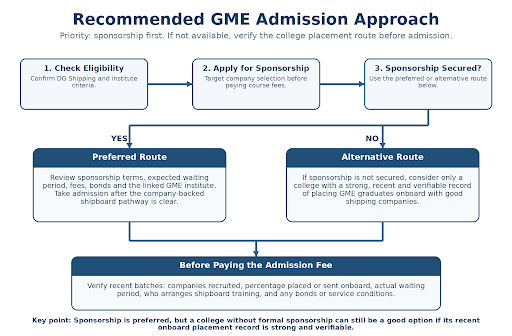
- Check GME eligibility
- Shortlist sponsoring companies and reputable GME institutes
- Apply for sponsorship or company selection first
- Clear the required test, interview and medical stages
- If sponsorship is secured, review the company terms, linked institute, waiting period, fees and service conditions
- If sponsorship is not secured, shortlist colleges with a strong and recent placement and shipboard-training record
- Verify recent batches: companies recruited, percentage placed or sent onboard, actual waiting period and who arranges shipboard training
- Take admission only when the route from GME to shipboard training is reasonably clear
Sponsorship remains our preferred route because it reduces uncertainty before you commit a major course fee. But a student should not reject a college only because it does not offer formal sponsorship. If that college has a consistently strong, recent and verifiable record of placing GME graduates with good shipping companies and arranging shipboard training, it can be a valid alternative. The real mistake is taking admission without evidence of how you are likely to get onboard after the course.
Sponsorship and Selection Process
For GME, our first preference is still sponsorship first and admission second. A formal company selection gives the clearest route into shipboard training. At the same time, sponsorship is not the only factor that should decide your college choice.
When can a non-sponsored college still be a good option?
- GME is only the pre-sea training stage. To progress toward the MEO Class IV competency route, you still need the required shipboard training or sea service.
- A genuine company sponsorship or official selection reduces uncertainty because the company-backed pathway is known before you pay the course fee.
- If sponsorship is not available, a college with a strong, recent and verifiable placement record can still be worth considering, especially when it regularly sends GME graduates onboard with established shipping companies.
- Do not judge a college only by the word “placement” in its brochure. Check what actually happened to recent batches: how many students were placed, which companies recruited them, and how long they waited to join ships.
- Do not confuse general placement assistance with a proven shipboard-training record. The important question is whether students are actually getting onboard in a reasonable time.
Before paying the admission fee, confirm these points:
- If sponsorship is offered, is the company selection official and clearly documented?
- If there is no sponsorship, what percentage of recent GME batches were actually placed or sent onboard, and with which companies?
- How long did recent students wait after completing GME before joining ships?
- Who arranges the shipboard training, and is there a clear process rather than only general placement assistance?
- Are there any bonds, service commitments, additional fees, withdrawal conditions or other important terms?
If you want to compare options at a basic level, see the College Portal.
GME Preparation and Career Guidance
SMVD Marine Academy
For aspirants who want structured GME sponsorship preparation, SMVD Marine Academy offers focused support for company exams and interviews through classroom coaching, structured tests, mock interviews and selection-oriented guidance. It can be especially useful for students who want a disciplined preparation environment before applying for sponsorship. Aspirants can check the latest GME programme, admission details and published results directly on the academy website.
Merchant Navy Decoded
Alongside this, Merchant Navy Decoded provides a broader digital learning and career-guidance ecosystem for Merchant Navy aspirants and seafarers. GME students can use its guidance resources, company and college information, sponsorship and interview content, and later continue with shipboard and competency-focused learning as their career progresses. This makes it useful not only during GME selection, but also as a continuing knowledge platform after joining the industry.
You can also access these resources through the Merchant Navy Decoded App, which brings maritime learning, career guidance, company insights, and useful seafarer resources together in one place. Download the app on Android or iOS to continue learning throughout your Merchant Navy journey.
Career Path After GME
This is where students need absolute clarity.
After GME, the normal path is not just ‘course complete = Fourth Engineer’. The better way to see it is shown below:
Diagram: Career path after Graduate Marine Engineering.
- Eligible Engineering Degree
- GME Course (1 year)
- Shipboard Training or Sea Service
- MEO Class IV Competency
- Fourth Engineer
- Third Engineer
- Second Engineer
- Chief Engineer
Titles during the training phase can vary. Some companies may use terms such as Trainee Marine Engineer, Junior Engineer, or Fifth Engineer. Do not get distracted by title differences. Focus on the training path, sea service, and competency progress.
For a broader understanding of rank structure, read Merchant Navy ranks, departments and duties.
Conclusion
Graduate Marine Engineering is a strong route for eligible engineering graduates who want to shift into the Merchant Navy engine department.
The route is valuable, but only when understood properly.
- Check your exact eligibility carefully.
- Do not assume every institute follows the same rules.
- Compare fees by inclusions, not only by headline number.
- Prefer securing sponsorship before admission. If sponsorship is not available, choose only a college with a strong, recent and verifiable placement and shipboard-training record.
- Remember that GME is the start of the path, not the final rank.
If a student understands these five points properly, most of the confusion around GME disappears.
Useful Verified Links
DG Shipping | IMU Admissions | SCI-MTI GME | Anglo-Eastern GME | How to Become a Marine Engineer | SMVD Marine Academy | Merchant Navy Decoded GME Resources
FAQs
Graduate Marine Engineering is a one-year marine-engineering training route for eligible mechanical engineering graduates who want to enter the Merchant Navy engine department.
The main eligible categories include Mechanical Engineering, certain Mechanical-core streams, eligible Naval Architecture streams and, in some cases, B.E./B.Tech Marine Engineering from a non-DGS-approved route, subject to current rules and institute acceptance.
The GME course itself is one year. But the full pathway also includes shipboard training or sea service and the MEO Class IV competency route.
There is no single nationwide average, as fees vary depending on the institute and what is included in the course package. As a general estimate, GME course fees may range from around ₹4 lakh to ₹7 lakh. Some institutes may charge more or less depending on facilities, training, accommodation, and other inclusions.
After GME, you move through shipboard training or sea service and the MEO Class IV competency route. After that, the normal engine-side progression is Fourth Engineer, Third Engineer, Second Engineer and Chief Engineer.
