GME Salary
If salary is one of the reasons you are considering GME, do not judge the career by one big monthly figure. A Trainee Marine Engineer, a Fourth Engineer and a Chief Engineer are at very different stages. Even at the same rank, two engineers may be paid differently because their companies, ship types and contracts are different.
This guide gives you the practical picture: what is fixed by regulation, what changes by company, and how dry- and wet-fleet salaries compare. If you also want the full course route, read the complete Graduate Marine Engineering (GME) guide.
GME Salary and Stipend Overview
First, clear up one common confusion: there is no single official ‘GME salary’ in India. DG Shipping controls the training and certification framework, but your employer decides what you are paid, how long the contract runs, whether leave pay is included and how promotions are handled. So two GME graduates can start at the same point and still earn different amounts.
The easiest way to understand the earning journey is to break it into three stages:
- Training stage: you normally sail as a Trainee Marine Engineer (TME) or Junior Engineer and receive a company-specific stipend or trainee wage.
- First officer stage: once you meet the MEO Class IV requirements, your company may place you as a Fifth Engineer, Fourth Engineer or another equivalent junior officer rank.
- Senior officer stage: as you move to Third Engineer, Second Engineer and Chief Engineer, pay usually rises with your CoC, responsibility, experience, vessel type and company wage scale.
Question | Practical answer | What to check |
|---|---|---|
Is GME salary fixed? | No — there is no one fixed salary. | Your company contract / SEA |
Is trainee pay the same everywhere? | No — trainee pay varies by sponsor. | Sponsoring company and training agreement |
Does rank guarantee the same salary? | No — the same rank can be paid differently. | Ship type, company, CBA and contract terms |
Trainee Marine Engineer Stipend
During onboard training, the stipend depends on the company. HIMT College’s current FAQ says companies generally pay about US$250-US$500 per month during onboard training based on CBA norms. Use that only as a broad training reference. Your actual offer may be lower or higher depending on the employer, training agreement, vessel, market and contract.
The practical takeaway is simple: do not assume every GME trainee gets the same stipend. A figure published by one company or institute applies to that particular arrangement. Before you accept an offer, read the sponsorship terms, SEA/employment agreement and onboard-training conditions carefully.
If you are comparing two sponsorship offers, get these points in writing:
- The monthly stipend or wage for the complete onboard training period.
- Whether the amount changes when you move from TME to Junior Engineer.
- The likely waiting time before your first ship and between later contracts.
- The contract length and whether leave pay is separate, included in the wage or not paid outside the contract period.
- Who pays for travel, medicals, courses, visas and joining expenses.
- Which rank the company normally gives after the first CoC and what you need to do to get promoted.
Salary After the First Promotion
This is usually where the first big jump in earnings happens. After you complete the required sea service, clear the MEO Class IV examination and assessment requirements, obtain the CoC and get promoted by your company, you move from trainee pay towards an officer wage. One important point: holding MEO Class IV does not automatically mean every company will call your rank ‘Fourth Engineer’. Companies can use slightly different rank ladders.
What does that jump look like in money? In 2026, many Fourth Engineer jobs on dry ships were around US$2,400-US$4,000 per onboard month. Oil/chemical tanker and LPG offers were commonly around US$2,500-US$4,800. Some specialist gas-vessel jobs paid more, but those roles often asked for relevant vessel experience.
So do not compare two offers by rank alone. Ask: what is this company paying for this rank, on this type of ship, under this contract? The rank gives you the broad salary level; the employer, vessel, experience requirement and contract explain why the final number can be quite different.
The dry-fleet and wet-fleet tables below make that difference easier to see without treating any one company as the industry standard.
Table of Contents
Rank-Wise Marine Engineer Salary
A useful way to read marine-engineer salaries is in three layers: rank first, company second and vessel type third. The figures below are recent advertised onboard wages or company-published examples. They are useful for comparison, but they are not guaranteed annual salaries.
How Salary Varies from Company to Company
There is a reason you rarely find one clean salary chart for every shipping company: most companies do not publish their full seafarer wage scale publicly. So the fair way to compare companies is to look at their fleet, operating model and your actual contract instead of taking one company’s salary chart and assuming everyone pays the same.
Company example | Company type/fleet context | What it means for salary comparison | Public salary information |
|---|---|---|---|
MSC Shipmanagement | Large owner/liner with a container-led fleet and other vessel segments. | Its own wage and promotion structure may differ from other employers. Any public MSC figure is an MSC example, not the market rate for every GME graduate. | Publishes a company-specific career-path salary example. |
Synergy Marine Group | Diversified third-party ship manager handling dry bulk, tankers, containers, LPG/LNG and other vessel types. | Pay can still change with the vessel owner, vessel type, CBA and assignment. Do not assume there is one universal “Synergy salary”. | No single public universal seafarer wage scale. |
TORM | Owner/operator focused on product tankers. | Its wet-fleet work has a different experience and salary context from container or bulk shipping. Tanker experience can affect both eligibility and pay. | No public universal seafarer wage scale found. |
The table above uses three companies from the GME research list to show three different employer models. The purpose is to show why salary context can change—not to rank the companies by pay.
Company examples: MSC Shipmanagement | Synergy Marine Group | TORM fleet
Dry Fleet Salary Comparison
Dry fleet is a broad term. A general cargo ship, bulk carrier and container ship can all pay differently, especially once you move into senior ranks. The table below uses representative US-dollar offers seen in recent 2026 listings, so read it as a market snapshot rather than a fixed industry average.
Rank | General cargo | Bulk carrier | Container ship | What stands out |
|---|---|---|---|---|
4th Engineer | ~$2.4k–3.6k | ~$2.4k–3.5k | ~$2.5k–4.0k | Big overlap — the employer can matter as much as the ship type. |
3rd Engineer | ~$2.5k–4.4k | ~$3.5k–4.3k | ~$3.7k–4.45k | Bulk/container offers sit slightly higher in this snapshot. |
2nd Engineer | ~$4.5k–8.0k | ~$7.0k–9.8k | ~$7.5k–8.6k | The pay gap becomes more visible at senior ranks. |
Chief Engineer | ~$6.5k–10.0k | ~$9.0k–12.2k | ~$9.5k–11.0k | Senior bulk/container offers are often strong. |
representative 2026 vacancies for general cargo, bulk-carrier and container ships, checked on 26 August 2026. Individual job links are not embedded because vacancies can expire or disappear.
Wet Fleet Salary Comparison
Wet fleet also needs to be broken down properly. An oil/chemical tanker, LPG carrier and LNG carrier do not sit in one salary bracket. They use different cargo systems, need different experience and compete in different hiring markets. In the current data, the biggest premium appears in specialist gas ships at senior ranks—but those jobs usually expect previous relevant experience.
Rank | Oil / chemical | LPG | LNG | What stands out |
|---|---|---|---|---|
4th Engineer | ~$2.5k–4.2k | ~$3.1k–4.8k | ~$7.74k* | LNG looks much higher here, but the sample is very small. |
3rd Engineer | ~$3.5k–5.3k | ~$4.5k–6.25k | ~$8.4k–9.0k* | Relevant gas experience can create a clear premium. |
2nd Engineer | ~$6.5k–12.2k | ~$9.0k–13.3k | ~$15.15k–19.0k | Specialist-vessel salaries spread much more at this rank. |
Chief Engineer | ~$12k–14.5k | ~$8k–14.8k | ~$20.8k–22.7k | LNG senior offers are the highest in this snapshot. |
*A word of caution on LNG figures: only five current vacancies were visible for both 4th Engineer and 3rd Engineer during this check. That is too small a sample to call the figures a ‘standard LNG salary’. Negotiable entries and an obvious US$1 data error were left out.
Market reference: representative 2026 vacancies for oil/chemical tankers, LPG carriers and LNG carriers, checked on 26 August 2026. Individual vacancy links are not embedded because they can expire or be removed.
How to Read These Salary Tables
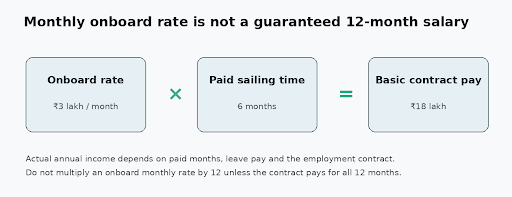
- Onboard monthly pay is not automatically a 12-month guaranteed salary. Check how many months you are likely to sail and whether leave is paid.
- A higher-paying vessel type does not mean a fresh GME graduate can enter it immediately. Tanker and gas jobs often ask for matching vessel experience, endorsements or previous experience in rank.
- Two jobs with the same headline salary can still give you different total earnings. One may include leave pay, overtime or bonuses; another may not. Compare the full contract, not just the monthly figure.
- Vacancy-board figures change all the time. Use them to understand the market, then confirm the current offer directly with the employer before making a decision.
Market-data note: the dry- and wet-fleet ranges above summarise recent 2026 vacancies visible during the final check on 26 August 2026. They show the shape of the market; they are not audited industry averages. Negotiable salaries and obvious data-entry errors were excluded.
Here is why this matters. Suppose an engineer earns ₹3 lakh for each onboard month and sails for six paid months in a year. The basic contract earnings are ₹18 lakh—not automatically ₹36 lakh. You should count the remaining six months only if the employment agreement actually pays for them. Leave pay, overtime, bonuses and allowances can of course change the final total.
Factors Affecting GME Earnings
Shipping company and wage scale
The company can make a real difference even when the ship type is the same. One employer may offer a single consolidated wage; another may show leave pay, overtime or bonuses separately. A ship-management company may also manage vessels for different owners, so two contracts under the same manager can still differ. Compare what you will actually be paid and for how many months—not just the company name.
Vessel type and specialised experience
A container ship, bulk carrier, general cargo ship, oil/chemical tanker, LPG carrier and LNG carrier do not share one wage scale. At junior ranks, you can see plenty of overlap. At senior ranks, specialist-vessel premiums can become much larger. LNG stands out in the current snapshot, but those jobs commonly ask for gas-carrier experience, so it should not be treated as an automatic next step for every GME graduate.
Certificate of Competency and actual company promotion
Think of certification and promotion as two separate things. Your CoC is the legal qualification; your onboard rank is the job the company gives you. DG Shipping sets the sea-service, training and examination requirements for MEO Class IV, Class II and Class I, but a company may still ask for more experience before promoting you.
For the official requirements, go straight to DG Shipping’s Merchant Shipping Rules page and check the latest STCW amendments, exam notices and engineering-branch instructions before planning your promotion timeline.
Contract length, leave pay and waiting time
A bigger monthly salary does not always mean bigger yearly earnings. If you spend long periods waiting between ships, your total annual income can fall quickly. When you compare two offers, look at paid months per year, likely waiting time, leave pay, rejoining bonus and any fixed or consolidated allowances.
USD/INR movement
Many international contracts are paid in US dollars. That means the INR value can move even when your dollar salary stays exactly the same. So treat rupee conversions in any salary article as a snapshot, not a permanent figure.
Tax status — do not assume every seafarer salary is automatically tax-free
You may see company pages or salary posts calling seafarer income ‘tax free’. Do not treat that line as a blanket rule for every Indian seafarer. The Income Tax Department determines residential status separately for each tax year and has specific rules for Indian citizens leaving India for employment or as crew of an Indian ship. Your final tax position can also depend on how and where the income is received.
For your own case, check the Income Tax Department’s current non-resident guidance and take professional tax advice instead of relying on a salary advertisement or a general statement online.
Career Growth and Long-Term Income
The biggest earning advantage of GME is not the first stipend. It is what can happen later as you gain sea time, clear your competency exams and move into higher-responsibility ranks. But remember: the fastest possible promotion route on paper is not the timeline everyone actually achieves.
When you plan your career, keep these four things separate:
- DG Shipping sets the minimum certification requirements you must meet.
- Your company decides when a suitable berth is available and when you are ready for promotion.
- Exam attempts, course dates and gaps between contracts can speed up or slow down your progress.
- Senior-rank salary depends heavily on the employer and vessel. For example, a Chief Engineer offer on a general-cargo ship should not be compared directly with a specialist LNG offer without checking the contract length, experience needed and leave-pay structure.
If you are still choosing where to do GME, give more weight to sponsorship and onboard-placement quality than to a small difference in trainee stipend. The Best GME Colleges in India guide can help you compare the training route alongside company opportunities.
You can also access these resources through the Merchant Navy Decoded App, which brings maritime learning, career guidance, company insights, and useful seafarer resources together in one place. Download the app on Android or iOS to continue learning throughout your Merchant Navy journey
Conclusion
GME salary can move from a modest trainee stipend to a strong officer income as you gain certification, experience and rank. But there is no single salary chart that fits everyone. The same rank can pay differently across companies, and the gap can become even wider when you compare dry ships with specialised wet-fleet vessels.
So when you compare GME options, do not stop at the first monthly number you see. Look at the sponsorship, how quickly you are likely to get onboard, the type of fleet you will gain experience on, the promotion path and the full contract. Those factors can shape your long-term earnings far more than a small difference in the trainee stipend.
FAQs
Usually, your first income after GME is a trainee stipend, not a full officer salary. HIMT College’s current FAQ gives a broad onboard-training estimate of about US$250-US$500 per month based on CBA norms, but actual offers can be lower or higher. The amount written in your own company offer is the one that matters.
Yes. GME trainees generally receive a stipend or trainee wage during structured onboard training, but the amount varies by company. Do not assume a figure quoted by one institute or employer applies everywhere.
There is no single figure because companies use titles such as ‘Junior Engineer’ and ‘Fifth Engineer’ differently. Once you hold the required Class IV CoC and move into an officer berth, current 2026 Fourth Engineer offers are broadly around US$2,400-US$4,000 on many dry ships and around US$2,500-US$4,800 on many tanker/LPG jobs. Specialist gas positions can pay more, but they usually ask for stronger vessel-specific experience.
The biggest factors are your rank, CoC, company wage scale, vessel type, specialised experience, contract length, leave pay and how consistently you sail. Even within the dry fleet, general cargo, bulk and container salaries can differ. Wet-fleet salaries can vary further across oil/chemical, LPG and LNG ships.
The biggest early jump usually comes after your onboard training and first CoC, but there is no guaranteed timetable. Your sea-service eligibility, exam results, company promotion policy, berth availability and gaps between contracts all affect how quickly your salary grows.
Research and link check: company examples, dry/wet vacancy ranges, DG Shipping rules, tax guidance and all inserted URLs were rechecked on 26 August 2026. Individual job-vacancy links were deliberately left out because they can expire. Salary figures are market examples, not guaranteed company wage scales.
